
Readers of Matthew, Mark, Luke, and John should be wondering what, if anything, could ever make Jesus Christ experience sorrow and fear while suffering. This question is absolutely vital to a personal discovery of the Passion of Jesus Christ.
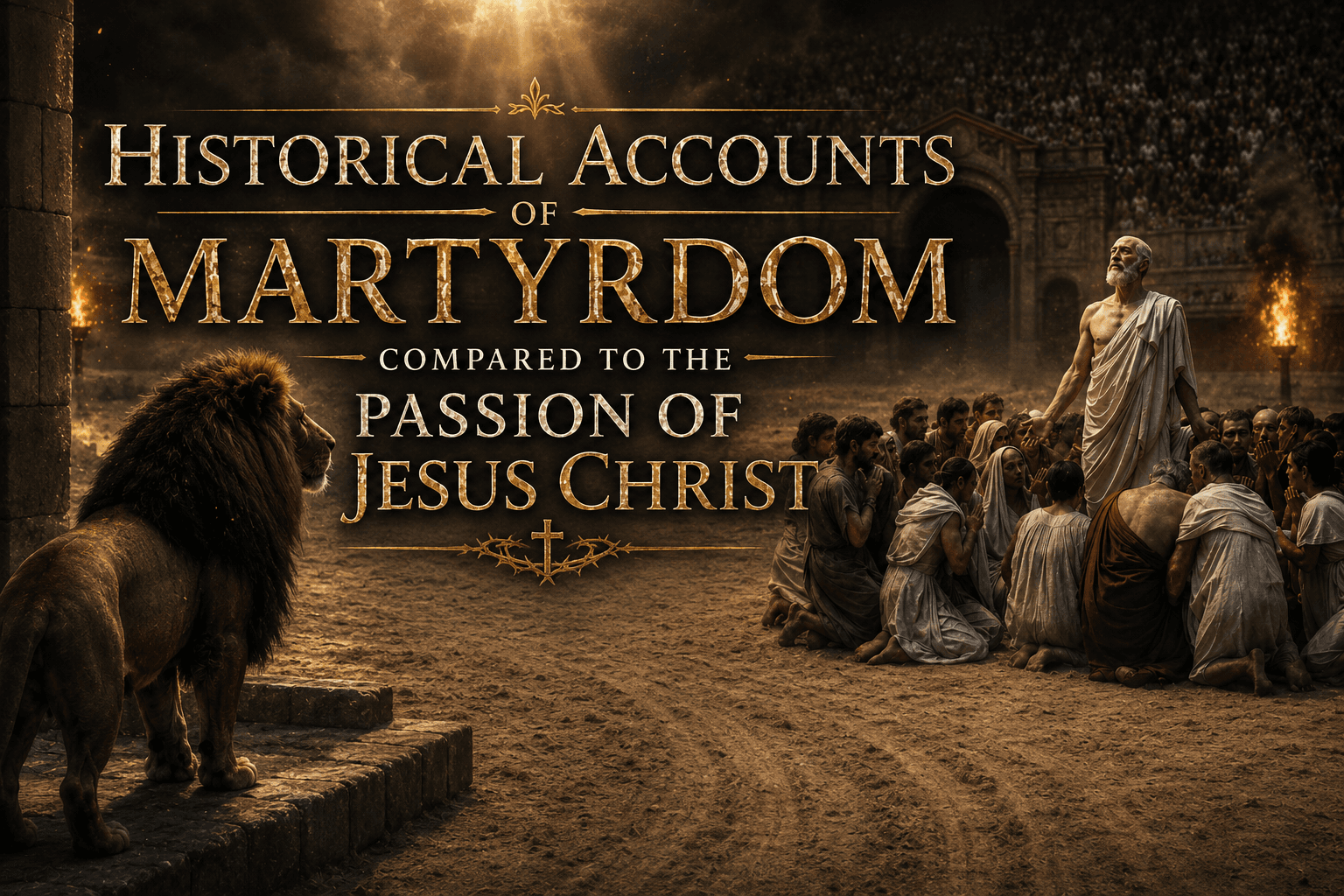
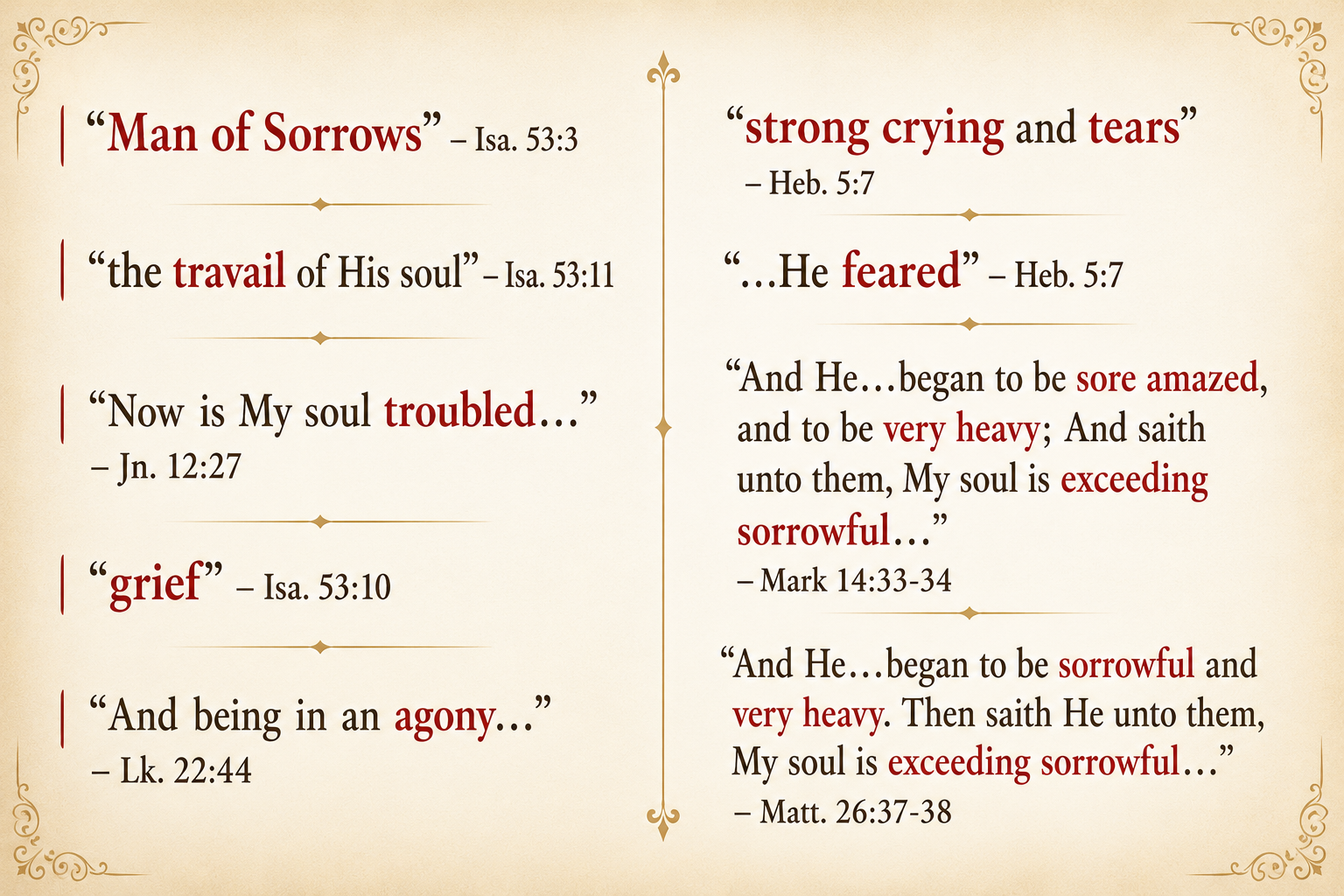
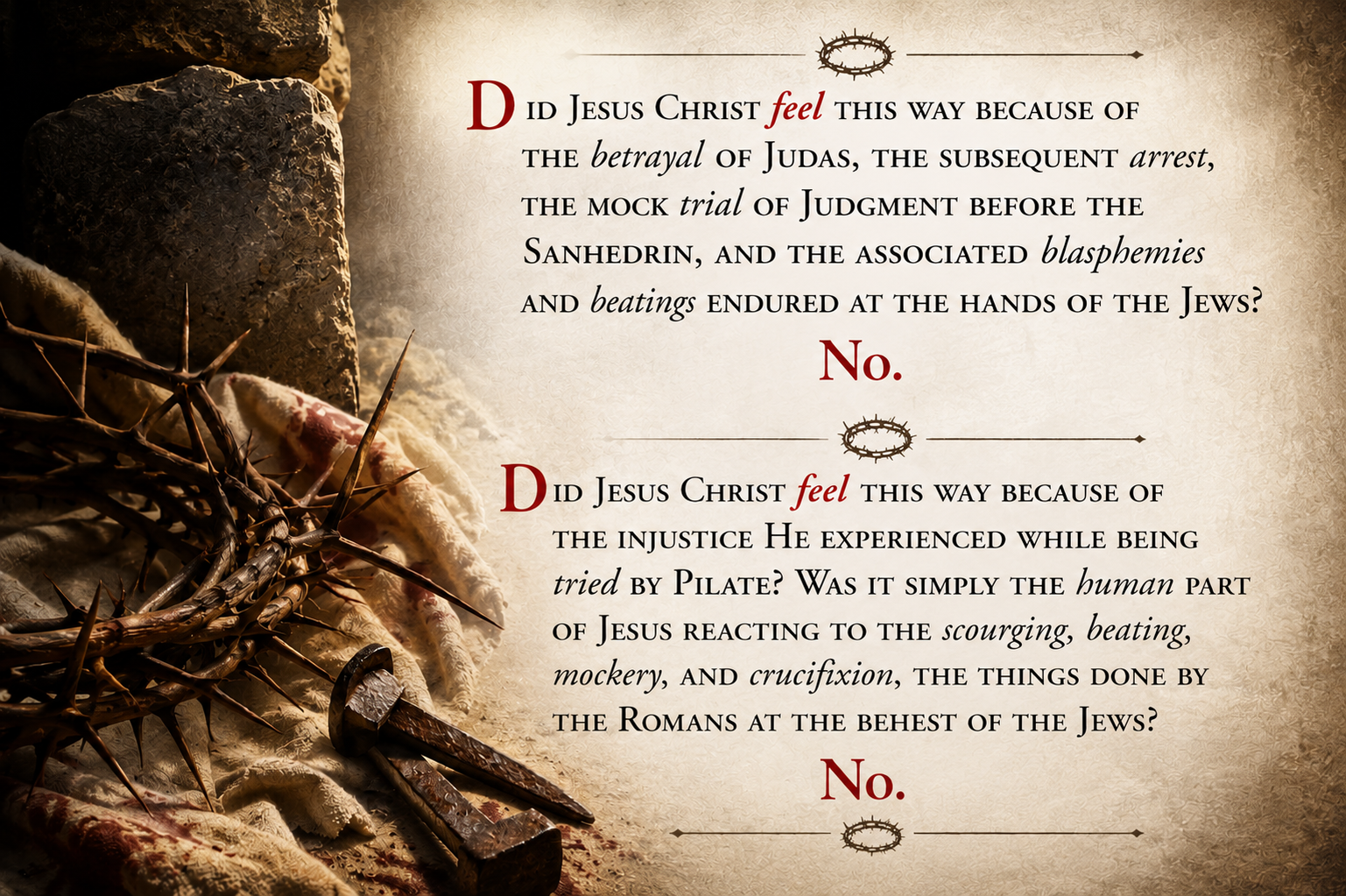
“It is dishonoring to our Lord to imagine Him less brave than His own disciples, yet we have seen some of the most feeble of His saints triumphant in the prospect of departing. Read the stories of the martyrs and you will frequently find them exultant in the near approach of the most cruel sufferings. The joy of the Lord has given such strength to them that no cowardly thought has alarmed them for a single moment–they have gone to the stake, or to the block with songs of victory upon their lips! Our Master must not be thought of as inferior to His boldest servants! It cannot be that He should tremble where they were brave. Oh, no! The noblest spirit among yon band of martyrs is the Leader, Himself, who in suffering and heroism surpassed them all!”- C.H. Spurgeon, The Agony in Gethsemane
“…the governor ordered him to be immediately scourged. He was then beaten with iron rods, set upon a wooden horse, and had his limbs dislocated. These tortures he endured with fortitude and perseverance; when he was ordered to be fastened to a large gridiron, with a slow fire under it, that his death might be the more lingering. His astonishing constancy during these trials, and serenity of countenance while under such excruciating torments, gave the spectators so exalted an idea of the dignity and truth of the Christian religion, that many became converts upon the occasion, of whom was Romanus, a soldier.”- Laurentius; in the eight persecution, under Valerian in A.D. 257; Foxe’s Book of Martyrs
“…the patience with which they met death: they seemed all resignation and piety, fervently praying to God, and cheerfully encountering their fate."- Persecution in Italy under Pope Pius the Fourth; Foxe’s Book of Martyrs
“…and when they had called the Apostles, and beaten them, they commanded that they should not speak in the name of Jesus, and let them go. And they departed from the presence of the council, rejoicing that they were counted worthy to suffer shame for His Name.” — Acts 5:40-41
“‘…I would not be separated from this noble company of martyrs:’ so saying, he cheerfully resigned his neck to the block.”- Persecutions in Bohemia under the Papacy
“On the morning of the day appointed for the execution, a cannon was fired as a signal to bring the prisoners from the castle to the principal market-place, in which scaffolds were erected, and a body of troops were drawn up to attend the tragic scene. The prisoners left the castle with as much cheerfulness as if they had been going to an agreeable entertainment, instead of a violent death.”- Persecutions in Bohemia under the Papacy
“He embraced the stake with great cheerfulness, and when they went behind him to set fire to the fagots, he said,"Come here, and kindle it before my eyes; for if I had been afraid of it, I had not come to this place."The fire being kindled, he sung a hymn, but was soon interrupted by the flames; and the last words he was heard to say these:—'This soul in flames I offer.’”- Jerome of Prague; Persecutions in Bohemia under the Papacy
“And Jesus answered them, saying, The hour is come, that the Son of man should be glorified. Verily, verily, I say unto you, Except a corn of wheat fall into the ground and die, it abideth alone: but if it die, it bringeth forth much fruit. He that loveth his life shall lose it; and he that hateth his life in this world shall keep it unto life eternal. If any man serve Me, let him follow Me; and where I am, there shall also My servant be: if any man serve Me, him will My Father honour.” — John 12:23-26
“The next day they were led to the place appointed for them to suffer; in their way to which, Russel, seeing his fellow-sufferer have the appearance of timidity in his countenance, thus addressed him:"Brother, fear not; greater is he that is in us, than he that is in the world. The pain that we are to suffer is short, and shall be light; but our joy and consolation shall never have an end. Let us, therefore, strive to enter into our Master and Saviour's joy, by the same straight way which he hath taken before us. Death cannot hurt us, for it is already destroyed by Him, for whose sake we are now going to suffer." When they arrived at the fatal spot, they both kneeled down and prayed for some time; after which being fastened to the stake, and the fagots lighted, they cheerfully resigned their souls into the hands of Him who gave them, in full hopes of an everlasting reward in the heavenly mansions.”- Jerom Russel & Alexander Kennedy; an account of the persecution in Scotland during the reign of King Henry VIII
“And Jesus answered them, saying, The hour is come, that the Son of man should be glorified. Verily, verily, I say unto you, Except a corn of wheat fall into the ground and die, it abideth alone: but if it die, it bringeth forth much fruit. He that loveth his life shall lose it; and he that hateth his life in this world shall keep it unto life eternal. If any man serve me, let him follow me; and where I am, there shall also my servant be: if any man serve me, him will my Father honour. Now is My soul troubled; and what shall I say? Father, save me from this hour: but for this cause came I unto this hour. Father, glorify thy name. Then came there a voice from heaven, saying, I have both glorified it, and will glorify it again. The people therefore, that stood by, and heard it, said that it thundered: others said, An angel spake to him. Jesus answered and said, This voice came not because of me, but for your sakes. Now is the judgment of this world: now shall the prince of this world be cast out. And I, if I be lifted up from the earth, will draw all men unto me. This he said, signifying what death he should die.” — John 12:23-33
“Looking unto Jesus the Author and Finisher of our faith; who for the joy that was set before him endured the C ross, despising the shame, and is set down at the right hand of the throne of God.” — Heb. 12:2
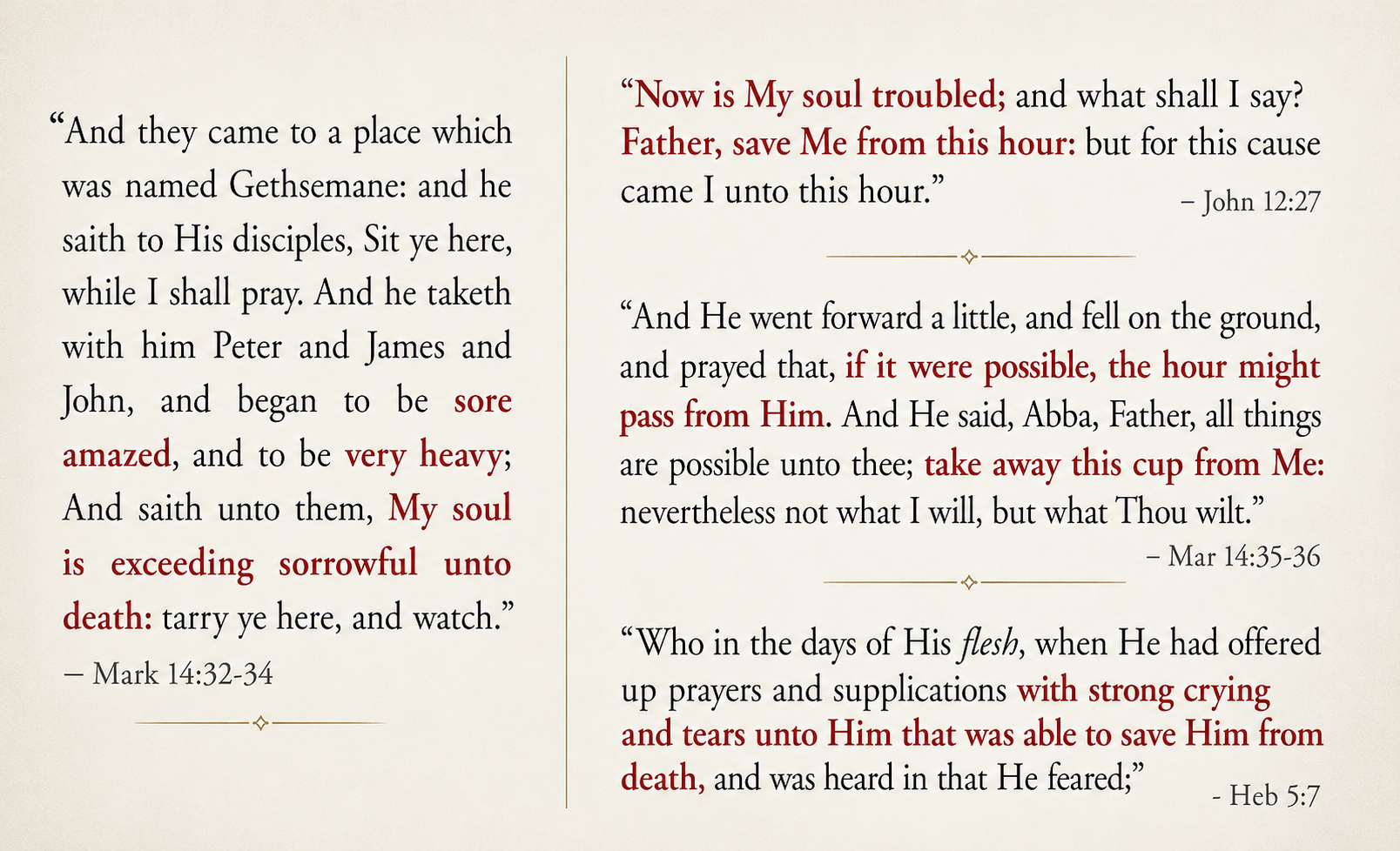
“And they came to a place which was named Gethsemane: and he saith to His disciples, Sit ye here, while I shall pray. And he taketh with him Peter and James and John, and began to be sore amazed, and to be very heavy; And saith unto them, My soul is exceeding sorrowful unto death: tarry ye here, and watch.” — Mark 14:32-34
“And all that sat in the council, looking stedfastly on him, saw his face as it had been the face of an angel.” — Acts 6:15
“Then came to him the mother of Zebedee's children with her sons, worshipping him, and desiring a certain thing of him. And he said unto her, What wilt thou? She saith unto him, Grant that these my two sons may sit, the one on thy right hand, and the other on the left, in thy kingdom. But Jesus answered and said, Ye know not what ye ask. Are ye able to drink of the cup that I shall drink of, and to be baptized with the baptism that I am baptized with? They say unto him, We are able. And he saith unto them, Ye shall drink indeed of my cup, and be baptized with the baptism that I am baptized with: but to sit on my right hand, and on my left, is not mine to give, but it shall be given to them for whom it is prepared of my Father.” — Matt. 20:20-23
“Being asked why he would obstinately persist in his opinions and leave his wife and children in distress, he replied, I shall not leave them in distress; I have recommended them to the care of an excellent trustee. What trustee? said the person who had asked the question, with some surprise: to which Faninus answered, Jesus Christ is the trustee I mean, and I think I could not commit them to the care of a better. On the day of execution he appeared remarkably cheerful, which one observing, said, it is strange you should appear so merry upon such an occasion, when Jesus Christ himself, just before his death, was in such agonies, that he sweated blood and water. To which Faninus replied; Christ sustained all manner of pangs and conflicts, with hell and death, on our accounts; and thus, by his sufferings, freed those who really believe in him from the fear of them. He was then strangled, and his body being burnt to ashes, they were scattered about by the wind.”- Faninus; an account of the persecution in Italy under the papacy
“The bitterness of sin was there, but He has taken that away for all who believe in Him. His Father’s wrath was there, but He drank that all up and left not a single drop for any of His people. One of the martyrs, as he was on his way to the stake, was so supremely happy that a friend said to him, ‘Your Savior was full of sorrow when He agonized for you in Gethsemane.’ ‘Yes,’ replied the martyr, ‘and for that very reason I am so happy, for He bore all the sorrow for me.’- C.H. Spurgeon, Christ in Gethsemane
“Gardiner himself was then tormented in the most excruciating manner; but in the midst of all his torments he gloried in the deed. Being ordered for death, a large fire was kindled near a gibbet, Gardiner was drawn up to the gibbet by pulleys, and then let down near the fire, but not so close as to touch it; for they burnt or rather roasted him by slow degrees. Yet he bore his sufferings patiently and resigned his soul to the Lord cheerfully.”- William Gardiner who was martyred by the King of Portugal
“This Nicholas Burton by the way, and in the flames of fire, had so cheerful a countenance, embracing death with all patience and gladness…”- the martyrdom of an English Merchant in Spain
“At Revel, Cateline Girard being at the stake… submitted cheerfully to the flames.”- Catelin Girard; an account of the persecutions the Waldenses in the Valleys of Piedmont
“Behold, I send you forth as sheep in the midst of wolves: be ye therefore wise as serpents, and harmless as doves. But beware of men: for they will deliver you up to the councils, and they will scourge you in their synagogues; And ye shall be brought before governors and kings for my sake, for a testimony against them and the Gentiles. But when they deliver you up, take no thought how or what ye shall speak: for it shall be given you in that same hour what ye shall speak. For it is not ye that speak, but the Spirit of your Father which speaketh in you.” — Matt. 10:16-20
“The governor of the castle, who stood so near that he was singed with the flame, exhorted our martyr, in a few words, to be of good cheer, and to ask the pardon of God for his offences. To which he replied,"This flame occasions trouble to my body, indeed, but it hath in nowise broken my spirit. But he who now so proudly looks down upon me from yonder lofty place (pointing to the cardinal) shall, ere long, be as ignominiously thrown down, as now he proudly lolls at his ease."Which prediction was soon after fulfilled. The executioner then pulled the rope which was tied about his neck with great violence, so that he was soon strangled; and the fire getting strength, burnt with such rapidity that in less than an hour his body was totally consumed.”- George Wishart of Scotland, Foxe’s Book of Martyrs; an account of the persecution in Scotland during the reign of King Henry VIII
“After the ceremony of degradation was over, the bishops delivered Dr. Huss to the emperor, who put him into the hands of the duke of Bavaria. His books were burnt at the gates of the church; and on the 6th of July, he was led to the suburbs of Constance, to be burnt alive. On his arrival at the place of execution, he fell on his knees, sung several portions of the Psalms, looked steadfastly towards heaven, and repeated these words:"Into thy hands, O Lord! do I commit my spirit: thou hast redeemed me, O most good and merciful God!" When the chain was put about him at the stake, he said, with a smiling countenance,"My Lord Jesus Christ was bound with a harder chain than this for my sake, and why then should I be ashamed of this rusty one?" The flames were now applied to the fagots, when our martyr sung a hymn with so loud and cheerful a voice, that he was heard through all the cracklings of the combustibles, and the noise of the multitude. At length his voice was interrupted by the severity of the flames, which soon closed his existence.”- John Huss; Persecutions in Bohemia under the Papacy
“…as James was led to the place of martyrdom, his accuser was brought to repent of his conduct by the apostle's extraordinary courage and undauntedness, and fell down at his feet to request his pardon, professing himself a christian, and resolving that James should not receive the crown of martyrdom alone. Hence they were both beheaded at the same time. Thus did the first apostolic martyr cheerfully and resolutely receive that cup, which he had told our Saviour he was ready to drink.” “Tobias Steffick was remarkable for his affability and serenity of temper. He was perfectly resigned to his fate, and a few minutes before his death spoke in this singular manner,"I have received, during the whole course of my life, many favours from God; ought I not therefore cheerfully to take one bitter cup, when he thinks proper to present it? Or rather, ought I not to rejoice, that it is his will I should give up a corrupted life for that of immortality!"- Foxe’s Book of Martyrs
“Now is My soul troubled; and what shall I say? Father, save Me from this hour: but for this cause came I unto this hour.” — John 12:27
“And He went forward a little, and fell on the ground, and prayed that, if it were possible, the hour might pass from Him. And He said, Abba, Father, all things are possible unto thee; take away this cup from Me: nevertheless not what I will, but what Thou wilt.” — Mar 14:35-36
“Therefore doth my Father love me, because I lay down my life, that I might take it again. No man taketh it from me, but I lay it down of myself. I have power to lay it down, and I have power to take it again. This commandment have I received of my Father.” — John 10:17-18
“And we have seen and do testify that the Father sent the Son to be the Saviour of the world.” — 1 John 4:14
“What shall we then say to these things? If God be for us, who can be against us? He that spared not his own Son, but delivered him up for us all, how shall he not with him also freely give us all things?” — Rom. 8:31-32
“And Abraham took the wood of the burnt offering, and laid it upon Isaac his son; and he took the fire in his hand, and a knife; and they went both of them together. And Isaac spake unto Abraham his father, and said, My father: and he said, Here am I, my son. And he said, Behold the fire and the wood: but where is the lamb for a burnt offering? And Abraham said, My son, God will provide himself a Lamb for a burnt offering: so they went both of them together. And they came to the place which God had told him of; and Abraham built an altar there, and laid the wood in order, and bound Isaac his son, and laid him on the altar upon the wood. And Abraham stretched forth his hand, and took the knife to slay his son.”- Gen. 22:6-10 [The Gospel = The Quintessential Expression of Sovereignty]
“I want your imaginations for one minute to picture a scene of olden times. There is a bearded Patriarch who rises early in the morning and awakes his son, a young man full of strength, and bids him arise and follow him. They hurry from the house silently and noiselessly, before the mother is awake. They go three days' journey with their men until they come to the mountain, of which the Lord has spoken. You know the Patriarch. The name of Abraham is always fresh in our memories. On the way that Patriarch speaks not one solitary word to his son. His heart is too full for utterance. He is overwhelmed with grief. God has commanded him to take his son, his only son, and slay him upon the mountain as a sacrifice. They go together. And who shall paint the unutterable anguish of the father’s soul, while he walks side by side with that beloved son of whom he is to be the executioner? The third day has arrived. The servants are bid to stay at the foot of the hill, while they go to worship God yonder. Now, can any mind imagine how the father’s grief must overflow all the banks of his soul, when, as he walked up that hillside his son said to him, “Father, behold the fire and the wood. But where is the lamb for a burnt-offering?” Can you conceive how he stifled his emotions and, with sobs, exclaimed, “My son, God will provide himself a lamb”? Look! The father has communicated to his son the fact that God has demanded his life. Isaac, who might have struggled and escaped from his father declares that he is willing to die if God has decreed it. The father takes his son, binds his hands behind his back, piles up the stones, makes an altar, lays the wood and has his fire ready. And now where is the artist that can depict the anguish of the father’s countenance when the knife is unsheathed and he holds it up–ready to slay his son? But here the curtain falls. Now the black scene vanishes at the sound of a Voice from Heaven. The ram caught in the thicket supplies the substitute and faith’s obedience needs go no further. Ah, my Brethren. I want to take you from this scene to a far greater one. What faith and obedience made man do, that love constrained God Himself to do. He had but one Son, that Son His own heart’s delight. He covenanted to yield Him up for our redemption, nor did He violate His promise. For, when the fullness of time was come, He sent His Son to be born of the Virgin Mary that He might suffer for the sins of man. Oh, can you tell the greatness of that love which made the everlasting God not only put His Son upon the altar but actually do the deed and thrust the sacrificial knife into His Son’s heart? Can you think how overwhelming must have been the love of God towards the human race when He completed in act what Abraham only did in intention? Look there and see the place where His only Son hung dead upon the Cross–the bleeding Victim of awakened Justice! Here is love indeed. And here we see how it was that it pleased the Father to bruise Him. This allows me to push my text just one point further. Beloved, it is not only true that God did design and did permit with willingness the death of Christ. It is, moreover true, that the unutterable agonies that clothed the death of the Savior with superhuman terror , were the effect of the Father’s bruising of Christ in very act and deed. There is a martyr in prison: the chains are on his wrists and yet he sings. It has been announced to him that tomorrow is his burning day. He claps his hands right merrily and smiles while he says, “It will be sharp work tomorrow. I shall breakfast below on fiery tribulations, but afterwards I will sup with Christ! Tomorrow is my wedding day, the day for which I have long panted, when I shall sign the testimony of my life by a glorious death.” The time is come. The men with the halberds precede him through the streets. Mark the serenity of the martyr’s countenance. He turns to some who look upon him and exclaims, “I value these iron chains far more than if they had been of gold. It is a sweet thing to die for Christ.” There are a few of the boldest of the saints gathered round the stake and as he unrobes himself, before he stands upon the fire wood to receive his doom, he tells them that it is a joyous thing to be a soldier of Christ–to be allowed to give his body to be burned. And he shakes hands with them and bids them “Good bye,” with merry cheer. One would think he were going to his wedding, rather than to be burned. He steps upon the fire wood. The chain is put about his middle. And after a brief word of prayer, as soon as the fire begins to ascend, he speaks to the people with manful boldness. But hark, he sings while the fire wood is cracking and the smoke is blowing upward. He sings and when his nether parts are burned he still goes on chanting sweetly some Psalm of old. “God is our refuge and strength, a very present help in trouble; therefore will we not fear, though the earth be removed and the mountain be carried into the midst of the sea.” Picture another scene. There is the Savior going to His Cross, all weak and wan with suffering. His soul is sick and sad within Him. There is no Divine composure there. So sad is His heart that He faints in the streets. The Son of God faints beneath a Cross that many a criminal might have carried. They nail him to the Tree. There is no song of praise. He is lifted up in the air and there He hangs preparatory to His death. You hear no shout of exultation. There is a stern compression of His face, as if unutterable agony were tearing His heart – as if over again Gethsemane were being acted on the Cross – as if His soul were still saying, “If it is possible let this Cross pass from Me. Nevertheless, not as I will, but as You will.” Hark! He speaks. Will He not sing sweeter songs than ever came from martyr’s lips? Ah, no–it is an awful wail of woe that can never be imitated. “My God, My God, why have You forsaken Me?” The martyrs said not that – God was with them. Confessors of old cried not so when they came to die. They shouted in their fires and praised God on their racks. Why this? Why does the Savior suffer so? Why, Beloved, it was because the Father bruised Him.- C.H. Spurgeon, The Death of Christ
The Doctrine of the Tree punctuates the Law in the Book of Joshua. This punctuation brings the needed closure to the story of divine wrath being depicted in the Law.
Read →God tested Abraham with the trial of his life. The word of the LORD came to Abraham, and the renowned Patriarch was immediately filled with unspeakable anguish. God commanded him to give up his son,
Read →In the presence of God the Consuming Fire, all eyes were fixed on Moses as a Mediator (Gal. 3:19). Similarly, Abraham said under inspiration, “God will provide Himself a Lamb for a burnt-offering” (Gen. 22:8).
Read →